AI Music Is Everywhere in 2026 — Here's Why Human Collaboration Still Wins
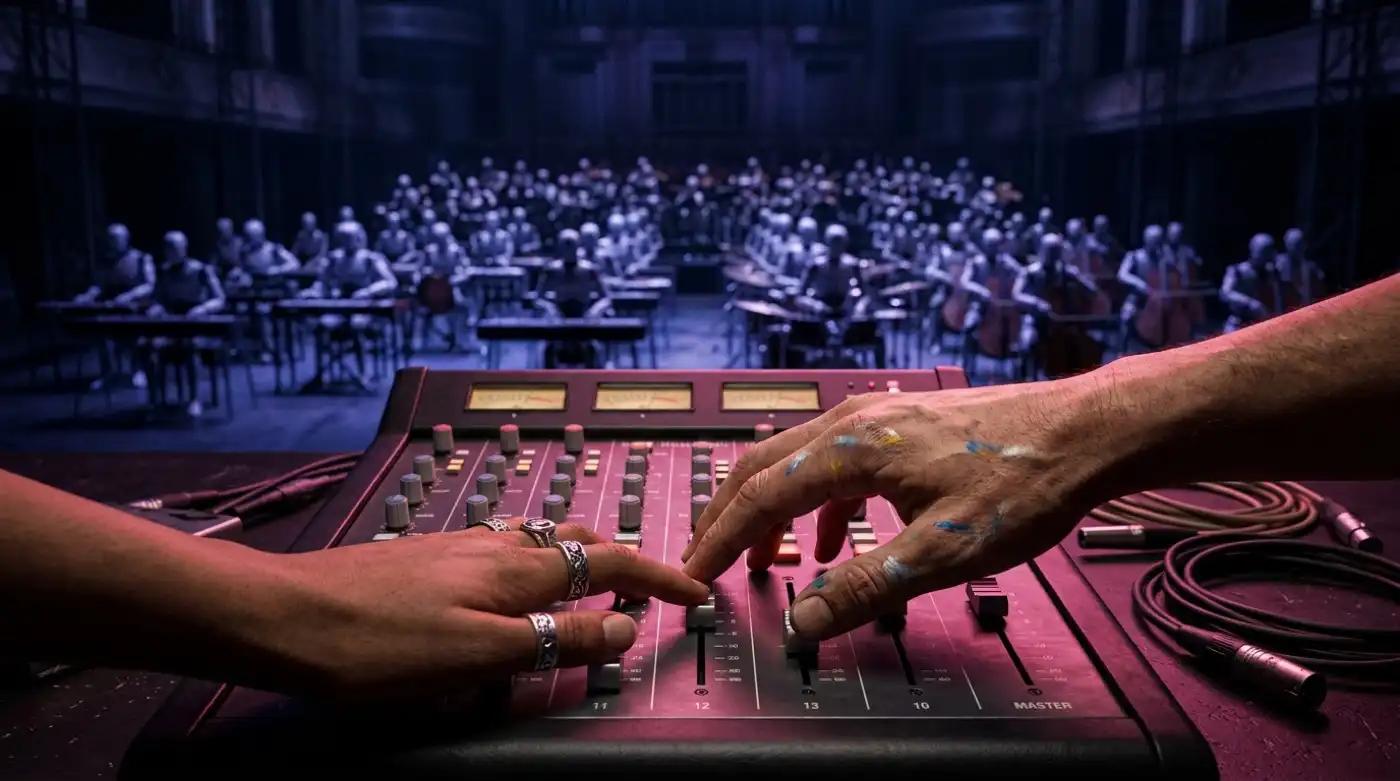
Two headlines landed in the same 24-hour window last week. The first: Deezer revealed that 43% of new users' playlists contain AI-generated music. The second: Mureka became the first "AI-native" music platform, promising to close the loop from AI creation to AI-powered listening.
Depending on your perspective, this is either the most exciting or the most terrifying time to be a music producer. But buried in the data — and in the reaction from the industry — is a more interesting story: the tools for human collaboration are growing faster than the tools for AI replacement.
Here's what the numbers actually tell us.
The 43% stat: what Deezer actually found
Deezer's new AI detection tool, launched this month, scans user libraries and playlists to identify AI-generated tracks. The headline number — 43% of new users have AI music in their libraries — sounds alarming. But the detail matters:
- The tool detects AI music alongside human-made tracks, not replacing them
- Most AI music in users' libraries comes from background music, lo-fi playlists, and functional audio (study beats, sleep sounds)
- In artist-driven genres — R&B, hip-hop, indie rock, electronic — AI music represents a much smaller fraction
In other words: AI is filling the background. Humans are still making the foreground.
This is consistent with what we're seeing on the production side. AI tools for mastering, stem separation, and noise reduction are being adopted rapidly — but they're assisting human producers, not replacing them. Serum 2 still needs a human to design the patch. Ableton still needs a human to arrange the track.
Mureka and the AI-native platform bet
Mureka's launch is genuinely significant. It's the first platform built from the ground up around AI music creation — not a feature bolted onto an existing DAW, but a complete rethinking of what a music platform looks like when AI is the default, not the add-on.
The pitch: type a prompt, get a track. Refine it. Release it. Let the AI handle distribution, metadata, and playlist optimization.
The reaction from the industry has been mixed. 29 organizations — including artist rights groups, publishers, and labels — just rallied behind a "No Consent, No Deal" framework for AI training. Their demand: artists must explicitly opt in before their work trains AI models, and forced AI clauses in label contracts must end.
This tension — between AI-native creation and human consent — is going to define the next five years of music tech. Platforms that ignore it will face legal and cultural backlash. Platforms that get the balance right will capture a market that's desperate for tools that respect the creative process.
Where the growth actually is: collaboration tools
While the AI headlines dominate, the quieter story is the growth of human-to-human collaboration platforms.
BandLab just launched a major update to its education-focused version, pushing deeper into schools and music programs. Their thesis: the next generation of musicians will learn to collaborate online before they ever set foot in a studio.
Native Instruments published a deep-dive with producers Nick Hook and Sascha Bühren on professional workflow — the unglamorous but essential craft of organizing sessions, managing versions, and keeping projects moving. The headline isn't "AI replaces producer." It's "producers are getting more serious about their tools."
In the same week, Splice expanded its collaboration features, and Endlesss — the real-time remote jamming platform — reported record usage among producers working across time zones.
The pattern is clear: AI is automating the mechanical parts of music production. Humans are doubling down on the creative parts. And the creative parts require better collaboration tools, not better AI.
What this means for producers and labels in 2026
1. AI is a tool, not a collaborator
Use AI for what it's good at: stem separation, noise reduction, quick mastering references, generating placeholder textures. Don't use it to replace the parts of music that require taste, intention, and human connection. Your collaborators can tell the difference.
2. Your workflow is your competitive advantage
When anyone can generate a beat with a prompt, the thing that sets you apart isn't the sounds you use — it's how you work. Can you take an idea from concept to master faster than the next producer? Can your team collaborate across time zones without friction? Your process is your product.
3. Human collaboration is the moat
AI can generate music. It can't generate trust, taste, or creative chemistry. When a label A&R listens to a track, they're not just hearing the audio — they're hearing the decisions, the taste, the collaboration behind it. That's not prompt-able.
4. The consent conversation isn't going away
If you're a producer, pay attention to how your tools handle training data. Platforms that train on user uploads without explicit consent are going to face increasing pressure — from artists, from labels, and from regulators. Choose tools that are transparent about their AI policies.
The bottom line
The Deezer stat is real: AI music is everywhere. But "everywhere" means background playlists and functional audio — not the records that people connect with, share, and remember.
Mureka and the AI-native bet are worth watching. But the bigger opportunity in 2026 isn't replacing human creativity — it's building the tools that make human collaboration faster, smoother, and more secure.
Your DAW handles the sound. Your collaboration platform handles the people. AI handles the background noise. That's the stack.
Soundisiak Studio is built for human collaboration — version control, per-track roles, and lossless streaming for teams that make music together. Start a free workspace.
Sources: Deezer AI detection tool announcement (June 2026), Mureka platform launch via Digital Music News, "No Consent, No Deal" framework via DMN, BandLab education update via Music Ally, Native Instruments workflow feature with Nick Hook & Sascha Bühren.