Skip to content

Artists

AI Music Is Everywhere in 2026 — Here's Why Human Collaboration Still Wins
Endless rows of identical robot musicians blurred in cold light, while two human hands meet in sharp warm focus on the same fader of a mixing console

Two headlines landed in the same 24-hour window last week. The first: Deezer revealed that 43% of new users' playlists contain AI-generated music. The second: Mureka became the first "AI-native" music platform, promising to close the loop from AI creation to AI-powered listening.

Depending on your perspective, this is either the most exciting or the most terrifying time to be a music producer. But buried in the data — and in the reaction from the industry — is a more interesting story: the tools for human collaboration are growing faster than the tools for AI replacement.

Here's what the numbers actually tell us.
Music Collaboration Platform: It's Not Just File Sharing Anymore

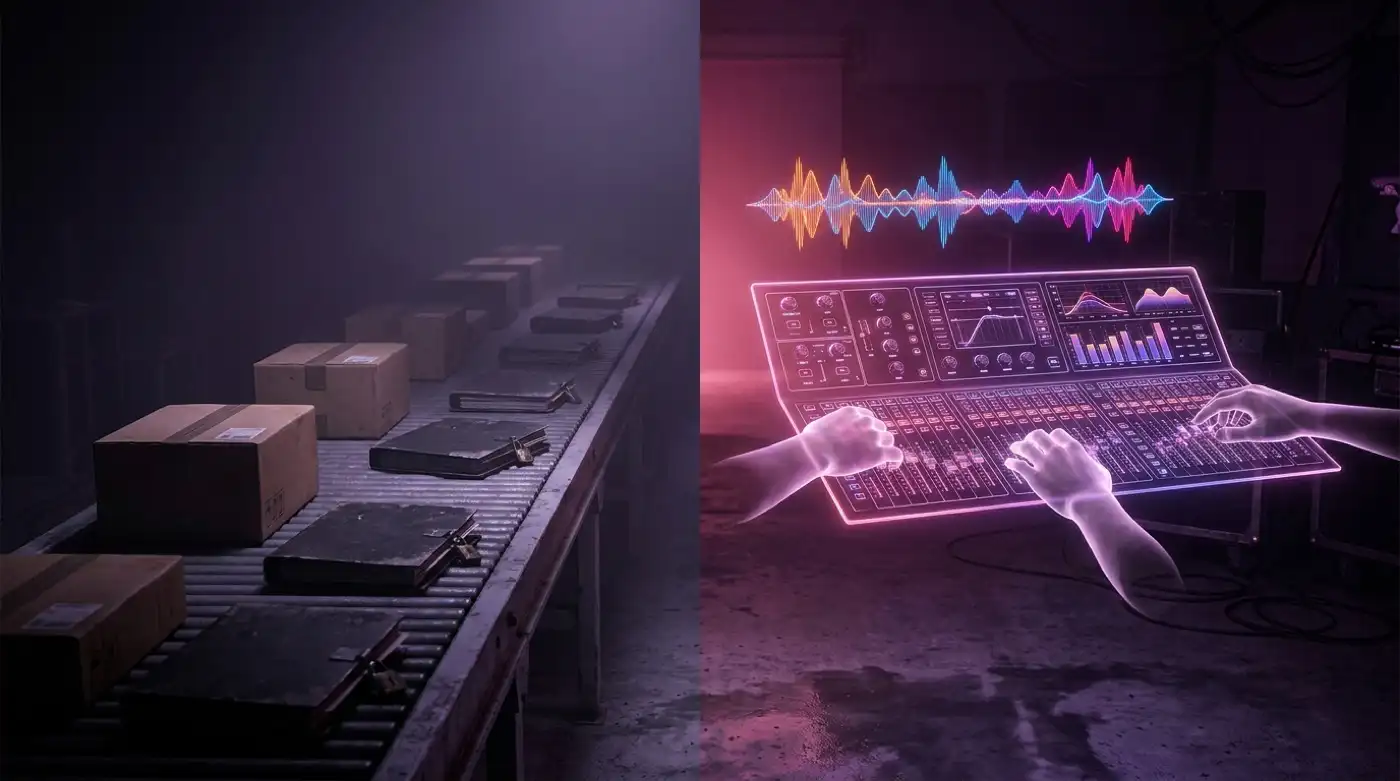
Sealed parcels on a grey conveyor belt dissolving into a shared holographic mixing console adjusted by several hands at once — file sharing versus a real music collaboration platform

The term "music collaboration platform" gets thrown at a lot of products. Dropbox with a waveform preview. Google Drive with a comments sidebar. WeTransfer with a "team" plan.

But sharing files isn't collaborating — any more than emailing a Word document is "co-authoring a novel."

A real music production collaboration software does three things that file-sharing tools can't: it knows who's doing what, it shows you where things stand without asking, and it lets the right people touch the right tracks without seeing everything else. Here's what that looks like in practice.

How to Organize Your Music Production Workflow (2026 Guide)

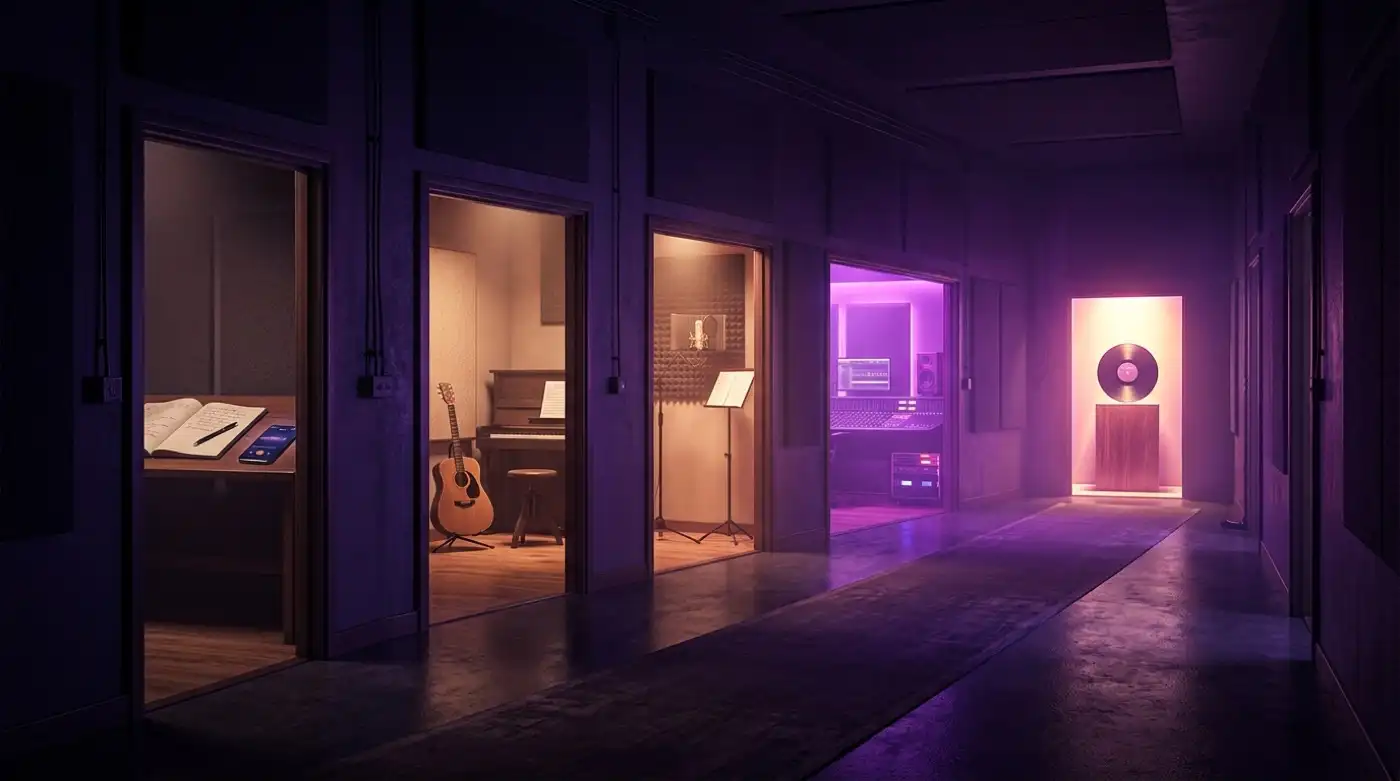
A studio corridor with five doorways, each brighter than the last — from a rough idea desk to a finished vinyl record, the five stages of a music production workflow

Most producers spend hours perfecting their signal chain and zero hours designing their workflow. The result: great-sounding music trapped in a chaotic process.

Your DAW is incredible at making sound. It is terrible at answering the questions that actually move projects forward: What needs to happen next? Who's working on what? Is the vocalist waiting on me, or am I waiting on them?

This guide is about the layer your DAW is missing — the workflow that turns scattered ideas into finished tracks.

Music Version Control: How to Stop Losing Takes Forever

In a dark archive of glowing audio reels, one tape is caught by a warm beam of light at the instant it starts crumbling into dust — version control rescues takes before they are lost

You record a bass line at 2 AM. It's rough, but there's something in it — a groove you know you'll use. You save it as bass_idea_3.wav and go to sleep. Three weeks later, you can't find it. It's buried in a folder called exports_march, between kick_sample_test.wav and a stray screenshot.

That take is gone. Not because you deleted it — because your file system ate it.

What Is Version Control for Music? The Complete Guide

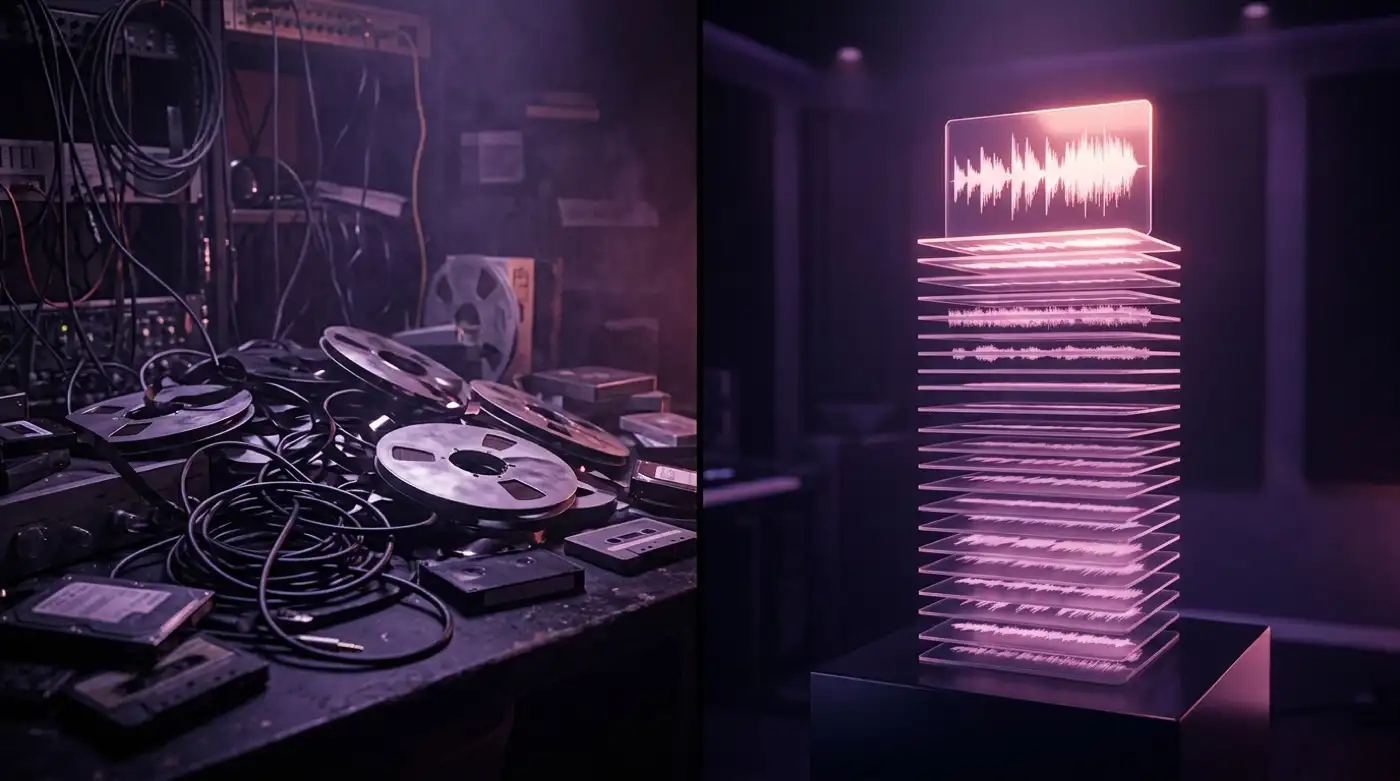
A cluttered studio desk of unlabeled tape reels and hard drives next to a clean glowing stack of ordered waveform versions — version control for music turns chaos into a timeline

If you've ever named a file final_mix_v3_REAL_FINAL_2.wav, you already know the problem. Version control for music solves it — but most producers have never used it, because DAWs don't ship with it and file-sharing tools weren't built for it.

This guide explains what music version control actually is, how it differs from Git or Dropbox, and what to look for when you're ready to stop losing takes.

The Rise of Afrobeats: How Technology and Global Collaboration Propelled a Musical Revolution

Beats, Bytes, and Borders: The Cultural and Technological Ascent of Afrobeats

In the past decade, Afrobeats has undergone a seismic transformation, evolving from a vibrant regional sound rooted in West Africa into a dominant force on the global music stage. Once the preserve of local clubs and radio stations in Lagos, Accra, and diaspora communities in London, Afrobeats now commands international attention—topping charts, selling out arenas, and influencing the sonic palette of mainstream pop, hip-hop, and dance music.

The Future of Home Studios: Budget-Friendly Innovations for 2025

In the early days of digital music production, achieving professional-grade results from a home studio was a daunting—and often prohibitively expensive—endeavor. High-end equipment, acoustically treated rooms, and specialized expertise were the exclusive domain of commercial studios and well-funded artists. Fast forward to 2025, and the landscape has been fundamentally transformed.

The Art of Remixing: Transforming Tracks into New Musical Experiences

Remixing stands at the intersection of technology and artistry, offering a sophisticated platform for creative expression, technical mastery, and musical innovation. For I.T. professionals, software engineers, and technology leaders with a passion for music, remixing is more than a creative outlet—it is a complex exercise in digital signal processing, software architecture, and real-time audio manipulation. This comprehensive guide delves into the technological foundations, creative workflows, and advanced techniques that define the modern art of remixing. By exploring the software architectures, algorithms, and AI integrations that underpin today's remixing landscape, this article equips you to transform tracks into compelling new experiences and appreciate the technical depth behind every beat.

How to Progress at Beatmaking

Beatmaking is a dynamic blend of creativity, technical skill, and continuous learning. This guide offers practical steps to help you improve your beatmaking skills and manage your music projects more effectively.